Showing posts with label Jam. Show all posts

Monday, 7 October 2024

Mulberry, Rhubarb & Mezcal Jam


It's a long weekend in October (the middle of Spring) which is perfect time for preserving.  This weekend, as if the produce gods knew I would have some spare time, I was randomly offered a bunch of rhubarb from a friend's mum's garden, and a bag full of fresh mulberries from another friend, picked off a tree in their back garden.  I'm a big fan of rhubarb jam and of mulberries too, so I figured combining them into a jam would be perfect.  


In my favourite pickling and preserving book, Saving the Season by Kevin West, there is a recipe for 'Rhubarb Jam with Mezcal' (p. 68).  West says that the 'fire-cooked, smoky quality' of mezcal blends surprisingly well with rhubarb.  I still have several bottles of mezcal from a trip to  Mexico (in June 2023) so adding this to my jam seemed like a great way to make a dent in all of this mezcal. 


Ingredients
  • 900g of mulberries, washed and de-stemmed.
  • 500g of rhubarb, finely diced
  • Juice of one lemon
  • 600g of sugar
  • Tablespoon of vanilla extract
  • 1/4 cup of Mezcal
  • Place a small plate in the freezer for testing the jam.
Recipe
  1. In a large bowl, combine the mulberries, rhubarb, lemon juice and sugar, and allow to macerate for about 30 minutes until the sugar has dissolved.
  2. Place the mixture in a pot and bring to the boil.
  3. Add in the mezcal.
  4. Reduce to thicken, stirring regularly to prevent scorching.
  5. Once it has thickened and is starting to splatter, test the jam using the cold plate.  Place a teaspoon of the jam on the plate and place it back in the freezer for 60 seconds.  
  6. If the jam is jelly-like in texture (forms a bit of a skin) and doesn't drip across the plate, then the jam is ready.


Sunday, 8 February 2015

Kiwifruit Jelly


Another trip to Canberra and another haul of kiwifruit!

Back in July 2014, at the peak of kiwifruit season, I helped pick kiwifruit from my girlfriend's family vines.  They were particularly abundant last year due to the way they had been pruned at the end of the 2013 season - the fruit was practically falling off the vines.

Picking kiwifruit, particularly when the vines have been grown over a pergola, is pretty labour intensive.  I would try to be strategic, get up on the ladder, reach for a large bunch, and give it a good yank, but inevitably that action would cause the surrounding fruit to rain down, mostly straight onto my head. It's like be pelted with hairy golf balls.


The other issue with picking kiwifruit is that a lot of them are too small to be eaten, or might be bruised or partially chomped on by birds.  We went through a sorting process to discard the dodgy ones, and then sorted the rest into smaller and larger sizes.  The larger ones were set aside to eat fresh, and I decided to use the smaller ones to make a kiwifruit jelly.

I had previously made kiwifruit jam using store-bought kiwifruit.  The store-bought variety are much less hairy than the variety we picked, and due to this hairiness, it would be difficult to make a jam - a lot of hair could easily have ended up in the mix with the fruit.

A jelly, as opposed to a jam, is strained through muslin, so I thought it would be perfect to take the jelly approach to filter out any incidental kiwifruit hair that made its way into the mix while processing the fruit.


Picking the kiwifruit is only the first step.  The next is to wait until they ripen.  Surprisingly, it took about three weeks to ripen and soften enough that we could scoop out the flesh. If you store the kiwifruit with other fruit, particularly bananas, the ripening process will be much faster.

The recipe I used is an adapted Feijoa jelly recipe.  The ingredients of the jelly are really simple - some lemon juice is added into the mix to help bring out the pectin.

The resulting jelly is really refined and delicious, but has a fantastic tanginess.  It also spreads really nicely across a piece of toast, and is even better with fresh scones!


Kiwifruit Jelly Recipe

Ingredients

  • 2-3kg of kiwifruit;
  • water;
  • 1.5kg of white sugar.
Making the jelly:
  1. Wash the kiwifruit to get rid of any excess hair.
  2. Slice the kiwifruit in half.
  3. Using a spoon, scoop out the flesh of the kiwifruit into a bowl, discarding the skin.  Try to get a few people to help you - this process can take a while, particularly if the kiwifruit are small.  
  4. Place the kiwifruit flesh into a pot and add water to just below the level of the fruit. 
  5. Bring the mixture to the boil and then turn the heat down. Simmer the fruit mixture for around 40 minutes until the fruit has broken down (see photo above).
  6. Place a muslin cloth over a sieve and then strain the mixture through it.  Leave for a few hours until all of the syrup has been extracted.  If you push the mixture through it will affect the clarity of the jelly, making it more cloudy.
  7. Return the syrup to a new pot, measuring it as you go. Then add 3/4 cup of sugar into the pot for every cup of syrup.  
  8. Bring the mixture to the boil and reduce the mixture.  You will know when the jelly is ready by doing the cold saucer test (place a saucer in the freezer for 5-10 minutes until it is icy cold.  If you spoon a bit of the jelly on to the plate it should form a jelly-like glob rather than dispersing)
  9. When the jelly is finished, pour it into sterilised jars.  


Tuesday, 9 September 2014

Morgan's Strawberry Jam

by guest blogger and expert jam technician, Morgan Went


This is the second time in a week that I have made this batch of jam - it’s pretty popular and one of the easiest I have ever made. This recipe makes around 7 small jars.

Strawberry Jam

Ingredients:
  • 1kg strawberries
  • 1kg jam setting sugar
  • 1 lemon, juiced
Method:  
  1. Wash, hull and cut the strawberries.
  2. Add to a large heavy based saucepan with the sugar and lemon juice.
  3. Stir over high heat dissolving sugar.
  4. Bring to a boil.
  5. Boil 4 minutes, skimming the foam as you go, stirring occasionally.
  6. Test to check if it has reached setting point, continue to boil until this has been reached.
  7. Pour into sterilised jars.
Cut the strawberries as small as you like, they do cook down quite a bit. I like a mixture of different sized pieces, some people mash them a bit.

Sterilising Jars 
by far the easiest method to me is putting the jars and lids in a baking sheet in a low oven, leaving them while you make the jam. I lay foil or baking paper underneath mostly for any spills when filling the jars.
Setting 
This is the first time I have used additional pectin in my jam making. I’ve been a bit of a purist in the past but thought I might give it a go in the form of jam setting sugar. Let me tell you, this stuff works a treat! It’s sugar with apple pectin and citric acid, good for fruits low in pectin like strawberries, plums, peaches, figs… pretty much any fruit you want to make into jam, I suppose. The lemon in the recipe is be helpful to the setting process if there was no added pectin, so it’s kind of unnecessary now but I like it for the flavour, it lifts the strawberries (Jamie Oliver uses vanilla which I think would be too sweet, even for jam). 

I use both a sugar thermometer and the saucer-in-the-freezer technique to help me check if the jam will set. Jam setting point is 104°C or 220°F.

For the saucer menthod, put a saucer or two in the freezer when you begin the recipe. To test the jam, put a spoonful on the cold saucer and leave it for about half a minute. If it wrinkles when you put your finger through it it’s setting well and you can stop the boil.
Boiling
Apparently if you overcook strawberry jam the colour and flavour go downhill pretty quick - I’ve never boiled it for longer than 4-5 minutes and it’s fine. I believe 12 minutes is the breaking point but I’ve never tested that!
Skimming
This removes the ‘scum’ that appears when you make any kind of jam, can be a dirty colour (like when making plum jam) but strawberry jam scum looks more white. It’s the foam on top (as opposed to the bubbles from the boil). I like to skim as I go when the jam is boiling - it gives me something to do while I’m keeping an eye on it, and every now and then I remember to stir the jam in case any fruit is catching. You can skim at the end if you like.
Pouring 
I find it easiest to use a soup ladle to pour some jam into a measuring jug for easy pouring into the jars. Put the lids on pretty soon to seal, use a tea-towel on your hands, though!

Photography and Words by Morgan Went

Saturday, 5 April 2014

Peach Jam


It’s April now.  Summer left us and it took stonefruit season with it.  While there are still trays of peaches and nectarines around supermarkets, the peak of the season was around Christmas and New Year.

You may have seen my post on Apricot Jam back in January.  This was one of my favourite jams; it had such a vibrant and distinctive flavour.  My good results from the apricot jam made me curious as to whether peach jam would work out as well. 


While picking up some groceries at Harris Farm one Sunday morning, I saw that trays of peaches were on special, so I decided to buy a tray and lug it home.  The peaches reached peak ripeness midweek, so after work I got into my jam making groove. 

The jam making process for peaches is slightly more involved than with apricot jam:  you have to peel all of the peaches, but you don’t need to peel the apricots!  I’m told that some people can’t stand the feeling of peach skin – the furry, slightly coarse, almost fine hair-like surface can give people the heebie jeebies. If this is you, apologies for the graphic description, and you may want to try one of my other, less fuzzy recipes.


Plunging the peaches in boiling water for about 10 seconds, loosens the skin and makes the peeling relatively easy. 


Peach Jam Recipe

What you need:

  • 2kg of ripe peaches;
  • 1300g of caster sugar;
  • the juice of 1 lemon.
The jam making:
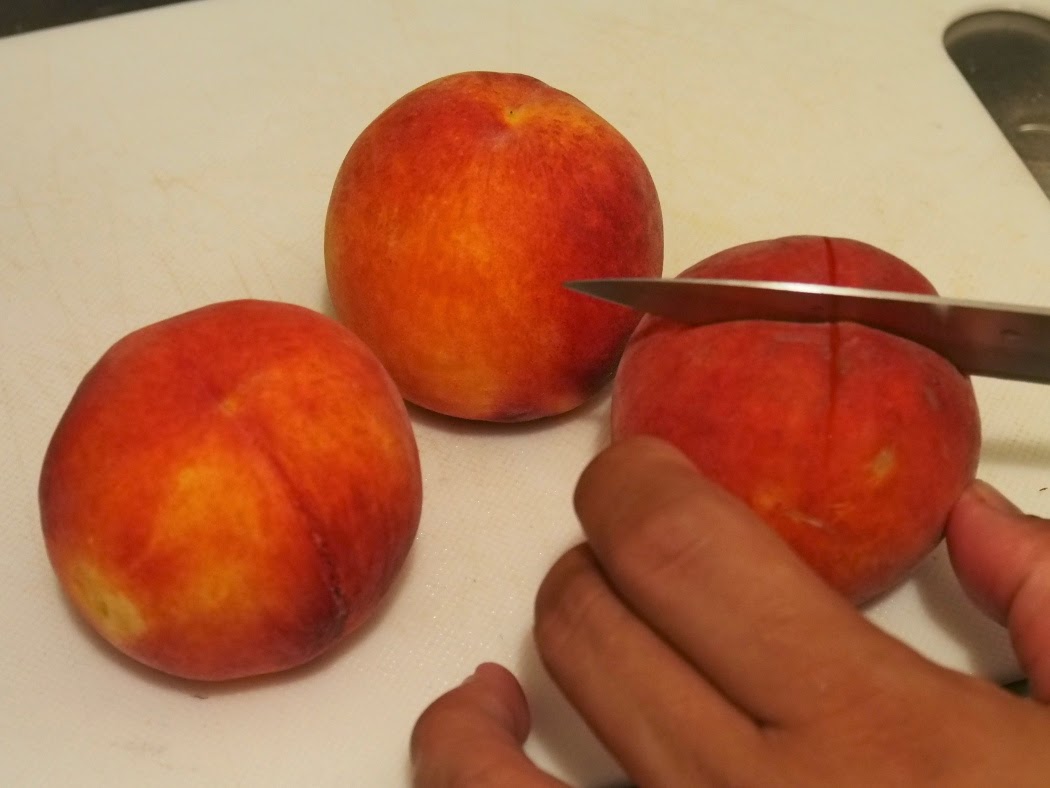
  1. Slice a small cross at the base of each peach.  The cross doesn’t need to be too deep.  
  2. Bring a large pot of water to the boil and then plunge the peaches in the water for ten seconds. 
  3. Peel the peaches once they have cooled down.  The skin should come away at the cross and should make peeling easy. 
  4. Cut the peaches into small pieces and remove the stones.  (You can set these stones aside to make some ratafia, or put them in with the jam to add extra pectin).
  5. Place the chopped peaches into a pot and cook on a medium heat for 5 minutes, or until the peaches start to soften.
  6. Pour in the sugar and the lemon juice and stir until dissolved.
  7. Keep stirring the jam, ensuring that it doesn’t burn or stick to the sides or bottom. 
  8. Reduce until the mixture has reached a jam-like consistency.


Sunday, 12 January 2014

Trevatt Apricot Jam


I spent Christmas this year in Canberra with my girlfriend's family.  Her dad is a gardening extraordinaire, so over the Christmas break I was constantly eating freshly grown produce. I had roast potatoes that had been pulled from the ground a few hours earlier.  A pavlova covered in freshly picked berries.  Peas that were carefully (or maybe not so carefully - we kept finding escapees all over the house for the rest of the week, excuse the pun) plucked from their pods.  It seemed like pretty much everything was in season, I guess that's summer for you.

The highlight however, was the fresh apricots that seemed to be rapidly multiplying on the apricot tree out the front of the house.  There was even enough to share with the cockatoos, though my girlfriend had other ideas and kept running out the front waving her arms like a crazy person to shoo them away. I think there is something about going to visit your parents at your childhood home that causes normally sane adults to revert to a childlike state.


In my view apricots are an underrated stone fruit, but possibly for good reason.  When my dad heard that I had come back to Sydney with a few kilos of fresh apricots he dropped the revelation that he had "never had a sweet apricot".  For a man who eats tonnes of fruit a day, it's a pretty bad appraisal for the apricot.

He does have a point though.  Plums and nectarines from supermarkets are often really sweet and tasty, but I've found store bought apricots to be floury and flavourless.  So my tastebuds exploded when I tried these fresh ones. Picked straight from the tree, at the peak of their ripeness, the taste is phenomenal.  


Apricots are in season in Australia between December and January.  My girlfriend's parent's tree was the Trevatt variety and was  just getting to peak ripeness around Christmas.  The drawback with this variety is that it doesn't keep well - they last approximately 3 days after harvest, and don't travel well - it would be hopeless as a commercial product.

Picking the fruit was tricky.  A lot of it was quite high up the tree, so I had to get up on a ladder to pick them (this was difficult for a clumsy, vertically-challenged person like me).  Some clusters of apricots were riper than others, but sometimes it was hard to tell while up on the ladder, so I might've picked some fruit before they were ripe. The good news is, stonefuit do ripen after harvest as long as they aren't too under ripe when picked.


Compared to the cherry jam I made a few weeks ago, the apricot jam was a much simpler process.  Removing the seeds from the apricots was really easy and the jam thickened quickly.  This batch of apricot jam was slightly runnier than I had expected.  I did the cold saucer test on it, and thought that the mixture was at the right consistency, but I think the large amount of pulp in the apricots may have deceived me! It was still really delicious but next time I will cook it down a little further.  


Apricot Jam Recipe

What you need:
  • 1kg of apricots, the sweeter the better;
  • 700g of caster sugar;
  • The juice of one lemon.
The jam-making:
  1. Firstly, prepare the apricots and try not to eat too many.  Slice each one in half and remove the seed.  
  2. Place all of the seed-less apricots into a pot with a splash of water.  Place on a medium heat for about five minutes until the apricots begin to break down.
  3. Now, add the sugar bit by bit, stirring so it dissolves into the apricot mixture.
  4. Squeeze in the lemon juice and bring to the boil.
  5. Cook the mixture down until it has reached a jam-like consistency.  Use the cold saucer test to check this, but make sure it's particularly thick - the apricot pulp can be deceiving.  


Monday, 30 December 2013

Cherry Jam and Cherry Picking in Wombat NSW


Blue Sky.  Wide open road.  A car (and stomach) full of cherries.

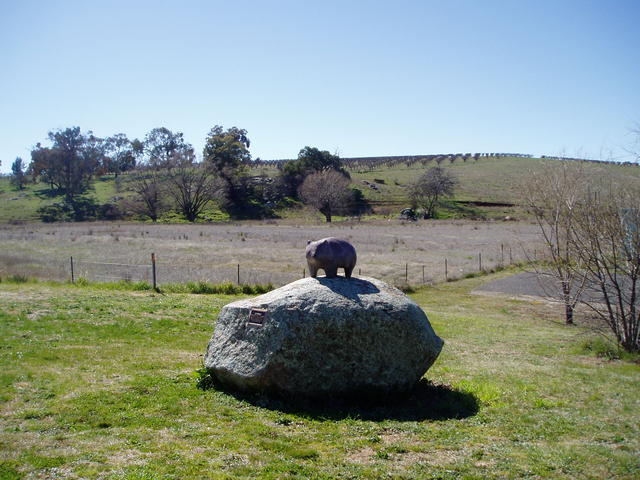
Earlier this month I went on a road trip to a cherry farm near Young.  Young is a town in the ‘South West Slopes’ region of NSW (according to Google) that’s known for its cherries, so much so that every year they have a cherry festival. My girlfriend’s folks drive there every year to pick their own fresh cherries.  Their favourite farm is in a town just outside of Young called Wombat (yes, there is a statue of a wombat next to the town’s pub) and goes by the name of Wombat Heights.  So when they mentioned that they would be going again this Summer, I thought it would be a good idea to tag along and bring back a haul for myself.


Wombat Heights is about a 4 hour drive from Sydney.  You pretty much drive towards Canberra, but then keep going past Yass and then turn right, and keep going a bit further. 

Once you get to the farm, the process is pretty simple to get picking – head past the ‘Grog Shed’ and the farmer will give you a large bucket and then send you off in the direction of the chosen cherry orchard.  Wombat Heights grows several varieties of cherries and other fruit in their orchards, so the cherry variety that you pick depends on day you go and what is ripe at that time in the season.  Some of the trees we meandered past had already been stripped bare by professional pickers (read backpackers) for commercial sale. 


The cherries we picked were a variety called ‘Ron’ (imaginative name – I assume some guy called Ron created/discovered them).  They have a dark red colour and an intense cherry flavour, and they were unbelievably and addictively sweet.  Cherries were $7 per kilo, which is about half the price you get at fresh food markets.  However, given we took a day off work, hired a car, paid the petrol, did the picking and had to stay in Canberra with my girlfriend's parents for the night, I’m not sure you could claim that it is an economically effective method of cherry procurement...


In the end we picked around 5 kilos of cherries and brought them back to Sydney.  Other than eating them non-stop, I was keen to make 2 things –  savoury pickled cherries and cherry jam (I'll talk about the pickled cherries in a later post).

The process of making cherry jam is tedious, mainly because you need to remove thousands (OK, hundreds) of pips.  To do this, you need to get hold of a cherry pipper.  This contraption cuts out the pip but keeps the rest of the cherry intact.  It’s a pretty messy process and I managed to cover the kitchen in bright red cherry juice - my girlfriend cleaned the kitchen the following week and discovered the remnants still on the ceiling.


The end product is a really delicious jam with a distinct, rich flavour.  Rather than chopping the cherries up, I kept mine whole, which means you get some good chunks of fruit throughout the jam, but they still soften and absorb the sugar.  The addition of lemon juice balances the sweetness of the cherries and conveniently adds pectin (a thickening agent) to the mixture. 

The recipe below came from my girlfriend’s dad, who makes it every year.  It’s unbelievably easy (once you've removed the pips).  Just add in sugar to two thirds of the total weight of the cherries plus the lemon juice.

Apologies to all the Jarhead readers out there – it’s been ages since I last posted.  I was in the Philippines throughout November, eating my weight in pork (checkout my Instagram to check out some pics of this ridiculous pork consumption).  Then December just flew by! But I’m back now, and I’ve got some great recipes to share in the next few weeks.  


My girlfriend's work were throwing out some vintage Dymo label makers... so we repurposed them.  

Cherry Jam Recipe

What you need:

  • 1 kg of fresh, pipped cherries;
  • 700g of caster sugar;
  • The juice of one lemon
Making the Jam:
  1. Place the cherries in a large pot, add a splash of water and bring to the boil.  Cook for 3 minutes until the cherries have begun to break down.
  2. Add in the sugar bit by bit, stirring it in so it dissolves.
  3. Add in the lemon juice and bring to the boil.
  4. Simmer on a medium to high heat until the mixture reaches a jam-like consistency (you can do the cold saucer test to check this.  See my post about kumquat marmalade for an explanation).  
  5. Place the jam into sterilised jars and seal.  For long term preservation, boil the jars in a water bath for 10 minutes.