Long time, no post! It's been a several months since I last posted something on Jarhead (work, uni and a butchery blog has been taking up all my time!) but rest assured the pickling has continued.
With the start of summer comes the beginning of cucumber season. Over the next few weeks I'll be posting about some different approaches I've taken to preserving cucumbers.

The last time I made cucumbers was in December 2013. I had eaten or given away most of the jars, but I had one remaining. I had stored the cucumbers in a mason jar and had processed it in a boiling water bath, so it should have been shelf stable. So I cracked it open and cautiously tasted the pickles - to my relief, they were still really juicy and delicious. The canning had been a success! They had definitely fermented a bit and had changed colour into a deep khaki, but the cucumbers still had structural pickle integrity and hadn't softened or deteriorated.
 |
| Year old pickles |
 |
| They were still delicious! |

That morning, Flemington markets was insanely
busy with lots of families stocking up on produce for the holiday season. Compared to last time when there was only one vendor selling Kirby cucumbers, there were actually several vendors offering them – the hard part was working out which ones had the prize cucumbers!

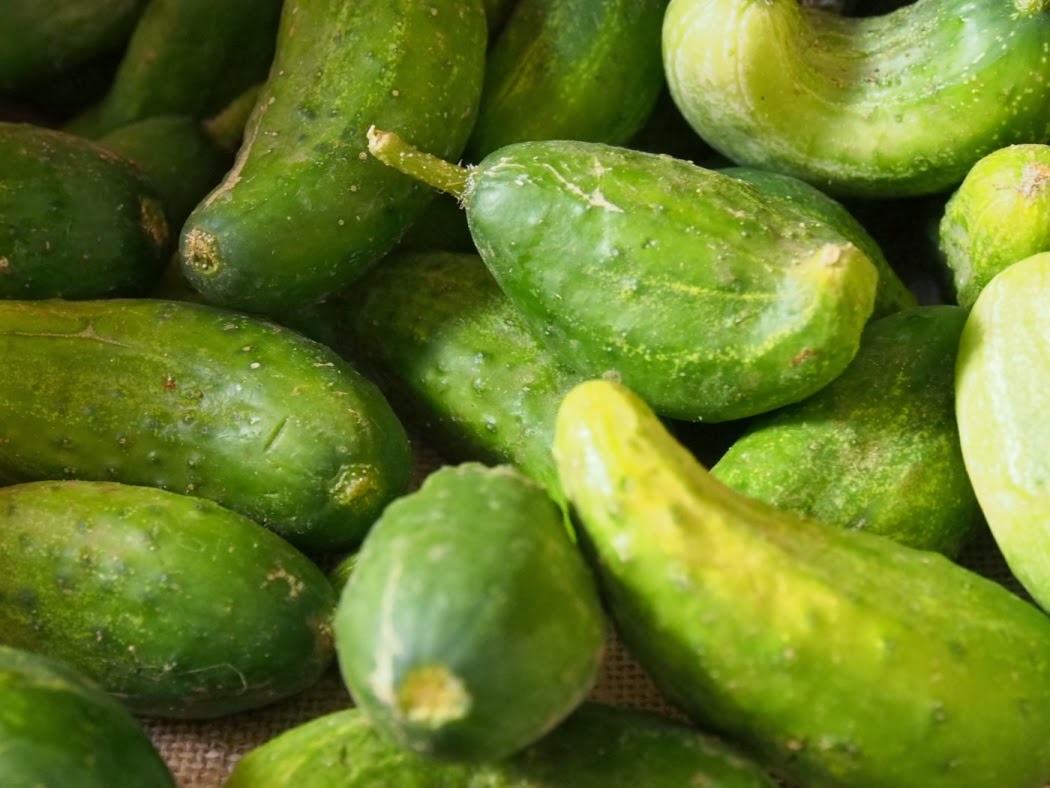
After circling the markets and spotting the cucumber vendors, I snapped up two crates of larger Kirby cucumbers from one vendor (I was lucky because they were his last crates!) These larger Kirby cucumbers looked like they had just been pulled out of the ground and had a bit of dirt on them, but nothing that couldn't be washed off. They came in different shapes and certainly weren't aesthetically perfect, but I really don't mind having some weirdly shaped cucumbers - they add character to the batch and, in any event, they can be cut up into spears and chips to fill the gaps between the whole cucumbers.
You need to look for a good size (smaller cucumbers are preferable as they tend to retain their shape and integrity once pickled), good colour (a nice shade of green with not too much yellow), not too much damage (but don't be turned off by a few imperfections), and firm feel – you don’t want a limp pickle! You can work around most of this, but just make sure the price you pay reflects the quality of the product.

Driving back home, I was slightly worried that I had gone overboard on the quantity - how was I going to be able to process all of these cucumbers in one weekend? When stacked up together, the pile of cucumbers was monolithic!

I wanted to give the pickled cucumbers to my family, friends and work colleagues as Christmas presents (I mean, who doesn't love pickles?) But as I started to rise and scrub the cucumbers, I realised that I would have enough cucumbers to give out as presents and still have a year's supply for myself!
I wanted to give the pickled cucumbers to my family, friends and work colleagues as Christmas presents (I mean, who doesn't love pickles?) But as I started to rise and scrub the cucumbers, I realised that I would have enough cucumbers to give out as presents and still have a year's supply for myself!
So I decided that I would process most of the cucumbers using the same recipe I used last time, but with slight tweaks to perfect it! Then, I would experiment and make a few different types of pickles, which I will post up on the blog in the coming weeks:
- Dill and Cucumber Relish;
- Turkish style cucumbers pickled in lemon juice;
- Fermented kosher pickles; and
- Spicy Korean cucumber pickles.

Jarhead's Perfect Pickled Cucumber (Gherkin) Recipe
I decided to use the
same recipe as last year to process most of the cucumbers. While I thought that the 2013 batch was
excellent, some sugar added to the brine would balance the flavour out.

Processing the cucumbers is time consuming. The first step of the process is letting the cucumbers sit in a salt brine overnight. I had containers of cucumbers sitting all over my small apartment, which ended up smelling like vinegar for a few days - I might need to invest in one enormous container for next time.
This part of the process really requires an extra pair of hands - or as many people as you can bribe to assist. Between heating the pickling brine, sterilising and packing jars, and then canning the jars in a large pot, there's just too much happening simultaneously for one person to manage.

But in the end I had more than 20 jars to give out as gifts. For a simple way of making an old jar look presentable, or at least somewhat 'rustic' and folksy, we tied some Xmas pudding calico over the lids using standard brown twine. They looked great!
Processing the cucumbers is time consuming. The first step of the process is letting the cucumbers sit in a salt brine overnight. I had containers of cucumbers sitting all over my small apartment, which ended up smelling like vinegar for a few days - I might need to invest in one enormous container for next time.
This part of the process really requires an extra pair of hands - or as many people as you can bribe to assist. Between heating the pickling brine, sterilising and packing jars, and then canning the jars in a large pot, there's just too much happening simultaneously for one person to manage.
But in the end I had more than 20 jars to give out as gifts. For a simple way of making an old jar look presentable, or at least somewhat 'rustic' and folksy, we tied some Xmas pudding calico over the lids using standard brown twine. They looked great!

Another tip for those starting out - labelling. I’ve found out the hard way how important it is to label your jars, at least with a manufacture date, but preferably also the contents - once you get a few batches going with different recipes it becomes very difficult to work out which is which. So invest in a label maker, or just a permanent marker!

Recipe
What you need:
- 1.5 kg of Kirby pickling cucumbers;
- 2 cups of apple cider vinegar;
- 8 cloves of garlic, peeled and sliced (I like them to be really garlicky);
- 1 teaspoon of fennel seeds;
- 2 tablespoons of coriander seeds;
- 1/4 cup of sea salt;
- 1 bunch of dill;
- 1 tablespoon of peppercorns;
- 3 tablespoons of sugar;
- 6 cups of water.
The pickling:
- Place the water in a pot and on a low heat, dissolve the salt, peppercorns; coriander seeds, and fennel seeds. Set this brine aside and allow to cool to room temperature.
- Wash and scrub the cucumbers well, making sure there's no spines or dirt.
- Slice off a thin round near the blossom end of the cucumbers. The blossom end contains an enzyme that can lead to the softening of the pickles. For any oddly shaped cucumbers that won't be easily packed into a jar, slice them into circular rounds (chips), or cut them lengthways into spears (quarters or halves). These chips and spears will be good for filing the gaps in a jar between the whole gherkins.
- Place the prepared cucumbers in a large plastic container and then cover in the cooled salt brine. Also add in a handful of dill. You can weigh down the cucumbers with a plate to ensure they're submerged. Leave them in the brine for 24 hours in the fridge or at room temperature.
- 24 hours later, measure out 2 cups of brine and put it aside. Sieve the rest of the brine and save the peppercorns and other aromatics.
- Then, pack the cucumbers into your clean, sterilised jars. As you pack them in, add in a sprig or two of dill in each jar along with some slices of garlic.
- Mix the vinegar and the reserved brine in a pot and bring to the boil. Add in the sliced garlic.
- Pour the boiling hot pickling brine over the pickles.
- For long term shelf storage you can process the jars in a boiling water bath for ten minutes. See the recipe in my post about Caramel Apple Jam for more information about processing jars in a water bath.