Showing posts with label Stone Fruit. Show all posts

Saturday, 5 April 2014

Peach Jam


It’s April now.  Summer left us and it took stonefruit season with it.  While there are still trays of peaches and nectarines around supermarkets, the peak of the season was around Christmas and New Year.

You may have seen my post on Apricot Jam back in January.  This was one of my favourite jams; it had such a vibrant and distinctive flavour.  My good results from the apricot jam made me curious as to whether peach jam would work out as well. 
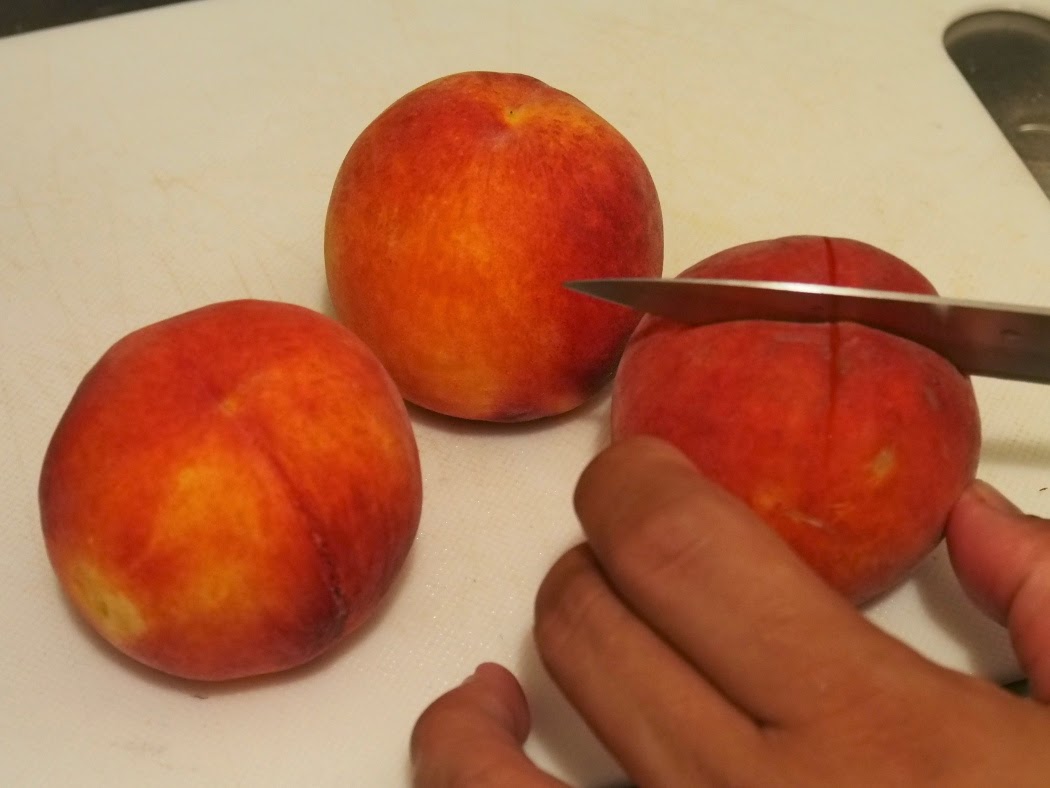


While picking up some groceries at Harris Farm one Sunday morning, I saw that trays of peaches were on special, so I decided to buy a tray and lug it home.  The peaches reached peak ripeness midweek, so after work I got into my jam making groove. 

The jam making process for peaches is slightly more involved than with apricot jam:  you have to peel all of the peaches, but you don’t need to peel the apricots!  I’m told that some people can’t stand the feeling of peach skin – the furry, slightly coarse, almost fine hair-like surface can give people the heebie jeebies. If this is you, apologies for the graphic description, and you may want to try one of my other, less fuzzy recipes.


Plunging the peaches in boiling water for about 10 seconds, loosens the skin and makes the peeling relatively easy. 


Peach Jam Recipe

What you need:

  • 2kg of ripe peaches;
  • 1300g of caster sugar;
  • the juice of 1 lemon.
The jam making:
  1. Slice a small cross at the base of each peach.  The cross doesn’t need to be too deep.  
  2. Bring a large pot of water to the boil and then plunge the peaches in the water for ten seconds. 
  3. Peel the peaches once they have cooled down.  The skin should come away at the cross and should make peeling easy. 
  4. Cut the peaches into small pieces and remove the stones.  (You can set these stones aside to make some ratafia, or put them in with the jam to add extra pectin).
  5. Place the chopped peaches into a pot and cook on a medium heat for 5 minutes, or until the peaches start to soften.
  6. Pour in the sugar and the lemon juice and stir until dissolved.
  7. Keep stirring the jam, ensuring that it doesn’t burn or stick to the sides or bottom. 
  8. Reduce until the mixture has reached a jam-like consistency.


Sunday, 12 January 2014

Trevatt Apricot Jam


I spent Christmas this year in Canberra with my girlfriend's family.  Her dad is a gardening extraordinaire, so over the Christmas break I was constantly eating freshly grown produce. I had roast potatoes that had been pulled from the ground a few hours earlier.  A pavlova covered in freshly picked berries.  Peas that were carefully (or maybe not so carefully - we kept finding escapees all over the house for the rest of the week, excuse the pun) plucked from their pods.  It seemed like pretty much everything was in season, I guess that's summer for you.

The highlight however, was the fresh apricots that seemed to be rapidly multiplying on the apricot tree out the front of the house.  There was even enough to share with the cockatoos, though my girlfriend had other ideas and kept running out the front waving her arms like a crazy person to shoo them away. I think there is something about going to visit your parents at your childhood home that causes normally sane adults to revert to a childlike state.


In my view apricots are an underrated stone fruit, but possibly for good reason.  When my dad heard that I had come back to Sydney with a few kilos of fresh apricots he dropped the revelation that he had "never had a sweet apricot".  For a man who eats tonnes of fruit a day, it's a pretty bad appraisal for the apricot.

He does have a point though.  Plums and nectarines from supermarkets are often really sweet and tasty, but I've found store bought apricots to be floury and flavourless.  So my tastebuds exploded when I tried these fresh ones. Picked straight from the tree, at the peak of their ripeness, the taste is phenomenal.  


Apricots are in season in Australia between December and January.  My girlfriend's parent's tree was the Trevatt variety and was  just getting to peak ripeness around Christmas.  The drawback with this variety is that it doesn't keep well - they last approximately 3 days after harvest, and don't travel well - it would be hopeless as a commercial product.

Picking the fruit was tricky.  A lot of it was quite high up the tree, so I had to get up on a ladder to pick them (this was difficult for a clumsy, vertically-challenged person like me).  Some clusters of apricots were riper than others, but sometimes it was hard to tell while up on the ladder, so I might've picked some fruit before they were ripe. The good news is, stonefuit do ripen after harvest as long as they aren't too under ripe when picked.


Compared to the cherry jam I made a few weeks ago, the apricot jam was a much simpler process.  Removing the seeds from the apricots was really easy and the jam thickened quickly.  This batch of apricot jam was slightly runnier than I had expected.  I did the cold saucer test on it, and thought that the mixture was at the right consistency, but I think the large amount of pulp in the apricots may have deceived me! It was still really delicious but next time I will cook it down a little further.  


Apricot Jam Recipe

What you need:
  • 1kg of apricots, the sweeter the better;
  • 700g of caster sugar;
  • The juice of one lemon.
The jam-making:
  1. Firstly, prepare the apricots and try not to eat too many.  Slice each one in half and remove the seed.  
  2. Place all of the seed-less apricots into a pot with a splash of water.  Place on a medium heat for about five minutes until the apricots begin to break down.
  3. Now, add the sugar bit by bit, stirring so it dissolves into the apricot mixture.
  4. Squeeze in the lemon juice and bring to the boil.
  5. Cook the mixture down until it has reached a jam-like consistency.  Use the cold saucer test to check this, but make sure it's particularly thick - the apricot pulp can be deceiving.